In the cultural genealogy of the Miao people, paper-cutting has never been a simple decorative craft, but a "wordless history book" engraved with ethnic memories. As an ethnic group without a common written language, the Miao people use a pair of scissors and a sheet of red paper to fold ancestor legends, migration journeys and life ideals into delicate patterns, passing them down from generation to generation.
1.Cultural Codes in Patterns: Visual Expression of Myths and Memories
The pattern system of Miao paper-cutting is a complete set of ethnic cultural symbols. Each pattern corresponds to a specific cultural connotation and carries the collective memory of the ethnic group.
- Eternal Motif of Creation Myths
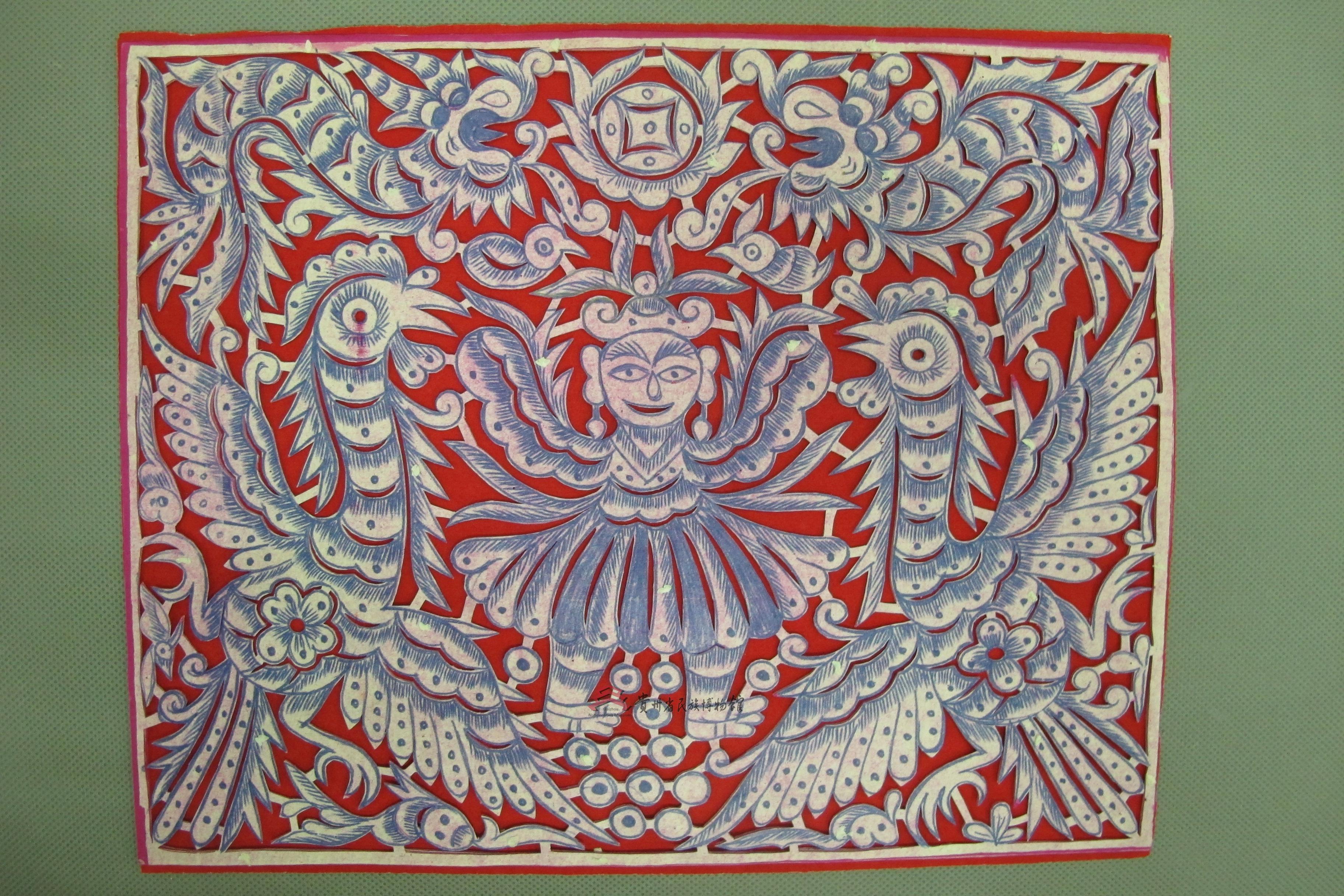
Mother Butterfly is the core motif in Miao paper-cutting. According to the Miao epic Ancient Miao Songs, Mother Butterfly was bred from the heart of a maple tree, laid twelve eggs, and hatched Jiang Yang, the ancestor of the Miao people, and all living things. This pattern appears repeatedly in various paper-cut works, bearing the Miao people’s awe for the origin of life and their clan identity. In addition, mythical stories such as Jiang Yang shooting the sun and Nüwa mending the sky are often presented in the form of paper-cutting, becoming the visual carrier of oral myths. - Secret Record of Migration Journeys
The Miao people experienced several large-scale migrations in history, and this long journey is also hidden in paper-cut patterns. Bird patterns correspond to the memory of ancestors using birds as guides during migration; fish and water patterns imply the migration route across rivers; maple patterns represent the former settlements of the ancestors. These patterns seem decorative, but are actually the Miao people’s secret remembrance of their ethnic origin, an epic without words.
Different from the festive and realistic style of paper-cutting in the Central Plains, Miao paper-cutting is full of primitive romantic imagination: human and beast integrated, flowers and birds coexisting, with exaggerated shapes free from natural rules. It presents a simple, wild and vibrant artistic temperament, which is the most direct visual projection of the Miao’s native culture.
2.Craftsmanship Inheritance: Spontaneous Folk Art Without Drafts
The most amazing thing about Miao paper-cutting is the technical wisdom of "draft-free creation". Artists do not need to draw drafts in advance. Relying only on the pattern memory in their hearts and muscle memory in their hands, they can complete intricate works in one go.
- Minimal Tools, Ultimate Craftsmanship
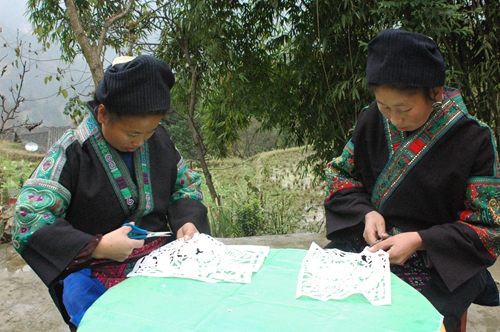
The tools for Miao paper-cutting are very simple: an ordinary pair of scissors and a sheet of bright red paper, no auxiliary tools such as carving knives or backing boards. Through folding, overlapping, hollowing, cutting and other techniques, artists can create patterns with rich layers and full details on a small piece of red paper. The finest works have lines as thin as hair, and the hollowed parts are even and neat, with no rough edges even under a magnifying glass, showing the ultimate skill of folk craftsmanship. - Family Oral Inheritance Context
The inheritance of Miao paper-cutting is mainly through female family members, following the traditional mode of "mother passing to daughter, mother-in-law passing to daughter-in-law". Girls usually start learning paper-cutting from elders at the age of seven or eight, starting with the simplest flower patterns, and gradually mastering complex content such as figures, mythical beasts and narrative scenes. This craft has no textbooks or atlases, relying entirely on oral teaching and daily practice, continuing the ethnic cultural genes at the fingertips of generations of women.
Miao paper-cutting in different regions has also formed distinct style differences: works in Taijiang and Jianhe of Qiandongnan are famous for their delicacy and complexity, with dense and full lines and strong decorativeness; while the style in Shibing and Huangping is more bold and vivid, with exaggerated shapes and strong local flavor. Different styles correspond to the cultural aesthetics of different branches, together constituting the rich artistic appearance of Miao paper-cutting.
3. Folk Art Embedded in Life: From Traditional Rituals to Contemporary Revival
Miao paper-cutting has never been an "elegant art" separated from life, but a cultural carrier deeply embedded in the daily life and rituals of the Miao people, playing an indispensable role in every important stage of life.

- Multiple Roles in Traditional Life
The core function of paper-cutting is to serve as the blueprint for Miao embroidery. Almost all embroidery patterns on Miao costumes are first shaped by paper-cutting, and then embroidered stitch by stitch by embroiderers. From the shoulders and aprons of festival costumes to children’s straps and personal pouches, all embroidery relies on the support of paper-cut blueprints. In addition, paper-cutting is also an important symbol in folk rituals: decorating dowries at weddings to imply happy marriage and continuous descendants; pasting on doors and windows during Miao New Year to pray for good weather and family prosperity; used as sacrificial offerings in funerals to express remembrance and blessings. - Contemporary Revival in the Intangible Heritage Era
Today, as a national intangible cultural heritage, Miao paper-cutting is stepping out of the mountains and embracing new development opportunities. The younger generation of inheritors has begun to explore the contemporary expression of traditional crafts: combining paper-cut patterns with cultural and creative products to develop peripherals such as bookmarks, decorative paintings and phone cases; integrating paper-cut elements into fashion design, appearing in clothing and household goods. At the same time, Miao paper-cutting has also appeared in international cultural exhibitions many times, showing the cultural charm of Chinese ethnic minorities to the world, and becoming a vivid witness to the diversity and unity of Chinese civilization.
For thousands of years, Miao paper-cutting has taken scissors as a pen and red paper as a scroll, writing the epic of an ethnic group without a written language. It hides the legends of ancestors, the long road of migration, as well as the passion for life and blessings for the future. It is not a static cultural relic, but a living cultural gene, passed down endlessly at the fingertips of generations of Miao people. Today, this folk art flower blooming in the mountains of southwest China is still growing through persistence and innovation, continuing the unique cultural roots and spiritual light of the Miao people.