1.Long History: The Thousand-Year Origin of Huixian Paper-Cutting
Huixian lies on the eastern foot of Taihang Mountains in northern Henan, bordering southeast Shanxi. Its unique geographic integration fosters a distinctive paper-cutting heritage. Hollow silver foil carvings unearthed from Warring States ruins in Guwei Village stand as the earliest physical relics of thin-sheet hollow craft in Central Plains, proving the origin of hollow visual art here dates back over 2,000 years to the Warring States Period. The mature folk paper-cutting format took shape in late Ming and early Qing dynasties, circulating widely across over fifty mountain villages in Shayao Township and Bobi Town. Mountain villagers used simple red paper and scissors to embed life aspirations into tiny paper artworks, passing down craftsmanship through generations.
In 2007, Huixian Paper-Cutting was listed in Henan’s first batch of provincial Intangible Cultural Heritage. In 2008, it was officially added to China’s National Intangible Cultural Heritage Extension List (No.Ⅶ-16), securing its core status in China’s folk paper-cutting system. Different from delicate Jiangnan paper-cutting and bold northwest styles, Huixian Paper-Cutting blends solemn Central Plains culture with unrefined Taihang rural simplicity, fully preserving farmers’ aesthetic thoughts and spiritual sustenance in agrarian society. Every piece serves as a visible illustrated history of rural life.
2.Craft Features: Unique Aesthetics of Taihang Rural Paper-Cutting
The core craft of Huixian Paper-Cutting prioritizes positive carving with auxiliary negative carving, its most distinguishable regional trait. Positive carving retains solid pattern lines while removing blank backgrounds, requiring artisans to master perfect control over strength, curves and hollow sizes for unbroken strokes. Sparse negative carving adds layered depth, creating striking visual contrast between solid and hollow spaces to build dimensional transparency. The full tool set is minimal: scissors of varying sizes, carving knives, red rice paper, wax boards and awls. Affordable and accessible materials suited ordinary farmers’ creation needs in ancient times.
Its compositional aesthetics carry strong Central Plains farming characteristics: fully filled frames with minimal blank space, following the folk belief that "fullness equals good fortune". Figures, livestock and flowers overlap freely without realistic perspective limits. Artisans apply exaggerated distortion to amplify auspicious motifs such as wheat ears, peonies and fruits, loosening human proportion rules and arranging dense-sparse elements to visualize people’s longing for abundant lives. Bold contrasting colors dominate traditional works: bright scarlet for celebration, golden yellow for wealth, stone green for vitality; interwoven hues amplify auspicious vibes.
The complete workflow follows strict steps: sketch drafts with pencils, fasten drafts to stacked rice paper layers, carve gradually from inner patterns outward, gently separate paper layers post-production, then trim or mount finished window and door stickers. No shortcuts exist—fluid tiny hollow cuts, curled peony petals and delicate animal fur lines demand decades of hands-on practice.

3.Pattern Meanings: Blessing Wishes Hidden in Paper-Cut Motifs
All motifs of Huixian Paper-Cutting draw from real lives of Taihang residents, divided into four major categories with clear auspicious connotations, acting as visual carriers of plain folk beliefs.
- First category: Auspicious flowers. Peony ranks as the most widely used core motif. Layered, fully bloomed paper-cut peonies symbolize prosperity and thriving households. Combined with phoenixes in "Phoenix Flying Through Peonies", they stand for happy marriages and complete fortune. Lotus represents peace and purity, pomegranate symbolizes many descendants, plum blossom signifies resilience; mixed floral patterns deliver wishes for year-round well-being.
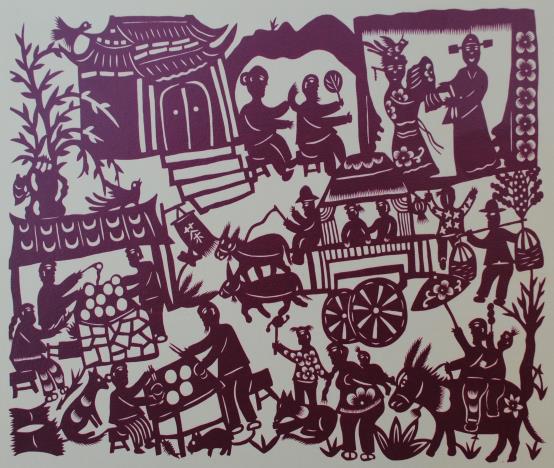
- Second category: Farming scenes, the most regionally distinctive theme. Artisans depict daily rural labor including wheat grinding, market gatherings, ploughing and livestock raising, featuring donkeys, oxen, grain silos and farm tools to record ancient Taihang village life. These works prioritize authentic life depiction over ornate decoration, embodying farmers’ simple wish for annual harvests and sufficient food.
- Third category: Folk opera and mythological figures. Opera tales and deity patterns appear widely on wedding and Spring Festival window cuttings, pasted in bridal chambers and halls to pray for family harmony and ward off bad luck. Wedding exclusive cuttings center on mandarin ducks, double happiness characters and lotus flowers, blessing couples with lifelong companionship and flourishing families.
- Fourth category: Modern innovative themes. Contemporary artisans break traditional limits by creating works about revolutionary history, rural revitalization and school aesthetic education, merging ancient craftsmanship with modern narratives. Huixian Paper-Cutting now enters primary and secondary school classrooms; children recreate classic patterns and design local motifs like hawthorns and medicinal herbs to pass culture across generations.

4.Living Inheritance: Present and Future of Huixian Paper-Cutting ICH
Once an essential decoration for every Taihang mountain household, Huixian Paper-Cutting adorned windows, bedding and ritual gifts during Spring Festival, weddings and birthday feasts, forming an inseparable part of life ceremonies. As urbanization simplified traditional folk customs, younger generations lost access to paper-cutting culture, while elderly craftsmen passed away year by year, pushing this national ICH to the brink of inheritance rupture.
Local cultural authorities launched systematic conservation projects. The Huixian Cultural Center built an ICH preservation hub, collecting hundreds of classic paper-cut drafts and fully documenting ancient carving procedures. Free public paper-cutting training courses run regularly for elder hobbyists and school students. Specialized ICH exhibitions display traditional and innovative works both offline and online to broaden cultural outreach.
Cross-boundary innovation also revitalizes Huixian Paper-Cutting: its patterns integrate into fashion design, porcelain ornamentation, cultural jewelry and souvenir creation. Ancient hollow aesthetics adapt to modern urban tastes, carrying this folk craft out of mountain villages into commercial city spaces. Thin red paper is no longer limited to festival decoration, evolving into a signature cultural tourism symbol of northern Henan, showcasing unique charm of China’s rural folk art to global audiences.
Thousand-year farming civilization of Central Plains nurtured Huixian Paper-Cutting. Every cut and stroke engraves people’s eternal longing for a better life. Rooted in Taihang mountains, this hollow art retains vigorous vitality after centuries, shining distinct charm of folk intangible heritage amid inheritance and innovation.
